
AI Is Power Shift
From Compute to Control
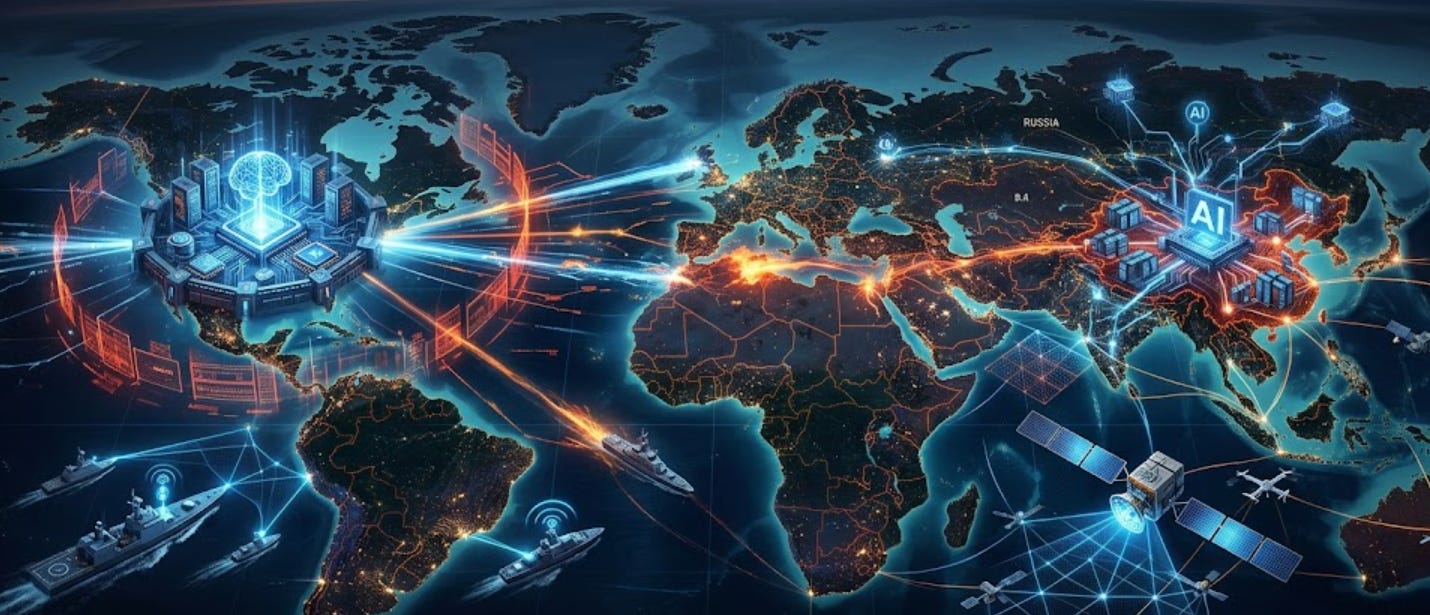
The Moment AI Became Geopolitical
AI is no longer just a technology sector.
It has crossed into geopolitics.
Recent developments make this shift undeniable:
expanding U.S. export controls on AI-related technologies
China accelerating state-led AI deployment
AI integration into military intelligence and surveillance systems
What changed is not just capability.
It is context.
AI is no longer competing within markets.
It is competing between nations.
From Performance to Resilience
The nature of competition has fundamentally shifted.
The early AI race was defined by:
model performance
training efficiency
algorithmic breakthroughs
Today, the focus has moved elsewhere.
From performance to resilience
The critical questions are no longer:
Who has the best model?
But:
Who controls the supply chain?
Who secures compute capacity?
Who can sustain deployment under disruption?
This introduces a new reality:
chip design matters
but chip manufacturing matters more
and energy supply matters most
AI is no longer an optimization problem.
It is a resource allocation problem.
Weaponized Interdependence
Global AI supply chains are deeply interconnected.
That interdependence is no longer neutral.
It is being weaponized.
Weaponized Interdependence defines the current phase of AI geopolitics.
Export controls are not simply restrictions.
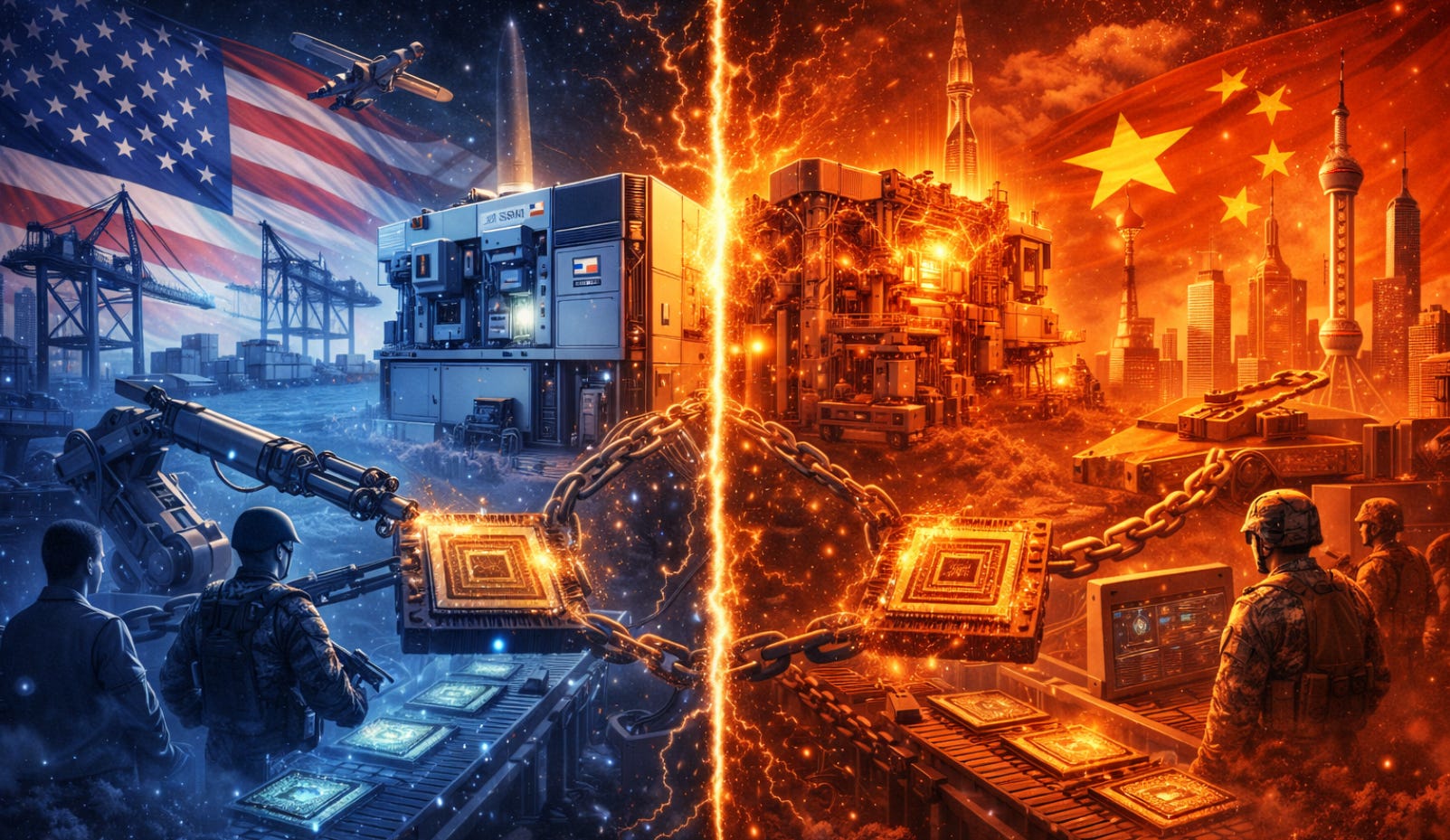
They function as strategic levers:
limiting access to advanced chips
restricting semiconductor equipment
controlling key manufacturing inputs
This creates a structural asymmetry:
one side controls critical nodes
the other side depends on them
In this system, control becomes power.
Supply chains are no longer economic structures.
They are enforcement mechanisms.
AI in Warfare – Intelligence Becomes Operational
AI is no longer confined to research or enterprise tools.
It is embedded in real-world operations.
Military systems now incorporate:
real-time intelligence analysis
decision-support algorithms
semi-autonomous operational tools
This changes the nature of warfare.
Speed becomes decisive.
Latency becomes risk.
The advantage shifts toward those who can:
process information faster
act on it sooner
integrate it into execution
AI is no longer assisting strategy.
It is becoming part of execution itself.
The New Bottleneck – From Code to Kilowatts
Despite rapid progress in AI models, a new constraint has emerged.
The bottleneck of intelligence has shifted from Code to Kilowatts.
AI is no longer limited by algorithms.
It is limited by:
energy availability
data center capacity
semiconductor supply chains
This marks a critical transition.
The competition is no longer about building smarter systems.
It is about sustaining them.
The decisive advantage now lies in
Supply Chain Resilience.
The countries that can:
secure energy
maintain hardware supply
scale infrastructure reliably
will define the next phase of AI dominance.
Compute Sovereignty and the Fragmentation of AI
As a result, the global AI system is fragmenting.
Countries are no longer willing to depend on external infrastructure.
Instead, they are pursuing:
Compute Sovereignty
This refers to the ability to:
generate
control
and sustain AI computation domestically
Much like energy independence in previous eras,
compute independence is becoming a defining metric of national power.
This shift leads to:
localized AI stacks
sovereign data infrastructure
parallel technological ecosystems
Globalization is giving way to controlled fragmentation.
From Commodity to Architecture of Power
The implications are structural and long-term.
AI is no longer a sector within the economy.
It is becoming the foundation upon which economies operate.
AI has evolved from a Digital Commodity
to the Foundational Architecture of National Power.
This transformation explains:
tightening export controls
aggressive infrastructure investment
rising geopolitical tension
The competition is no longer about innovation alone.
It is about control.
Final Insight
The AI race is not defined by who builds the most advanced model.
It is defined by who controls the system beneath it.
The ultimate victory lies not in owning the “Best Model,”
but in governing the “Substrate” upon which all models exist.
In this new landscape:
compute is power
infrastructure is strategy
resilience is dominance
AI is no longer a technology cycle.
It is a geopolitical system.