
Energy Shock Returns
Energy Shocks and the Limits of Systemic Resilience
The Collapse of the De-escalation Narrative
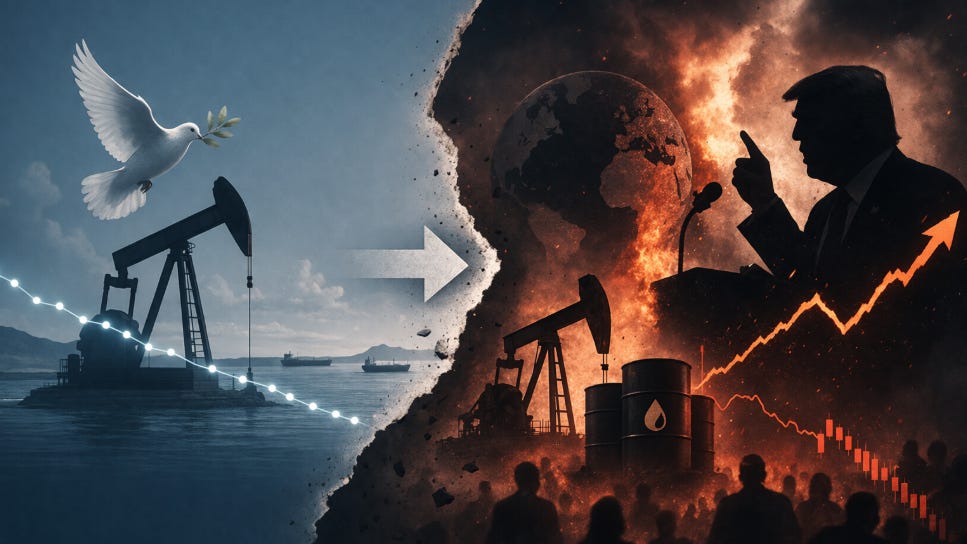
Markets entered early April anchored to a fragile assumption: that geopolitical tensions would gradually de-escalate and energy risks would normalize.
That assumption broke on April 2.
Following renewed signals from Trump suggesting a lower probability of near-term resolution, markets rapidly repriced risk.
Oil moved higher.
Risk sentiment weakened.
But more importantly:
The Geopolitical Risk Premium returned—abruptly and decisively.
This was not just a reaction to oil prices.
It was a repricing of uncertainty itself.
The Return of Supply-Driven Inflation
The current move in energy markets is not demand-driven.
It is supply-driven.
Geopolitical instability directly affects:
production expectations
transport security
embedded risk premiums
This leads to cost-push inflation, which differs fundamentally from demand-driven inflation.
It is:
more persistent
less responsive to policy
harder to anchor
Monetary policy can suppress demand.
It cannot produce oil.
The Second Wave: A System Under Fatigue
Markets are not facing the first energy shock.
They are facing a second wave—under weaker conditions.
This time, the system carries structural fatigue:
strategic reserves are depleted relative to prior cycles
interest rates are already restrictive
supply chains are fragmented
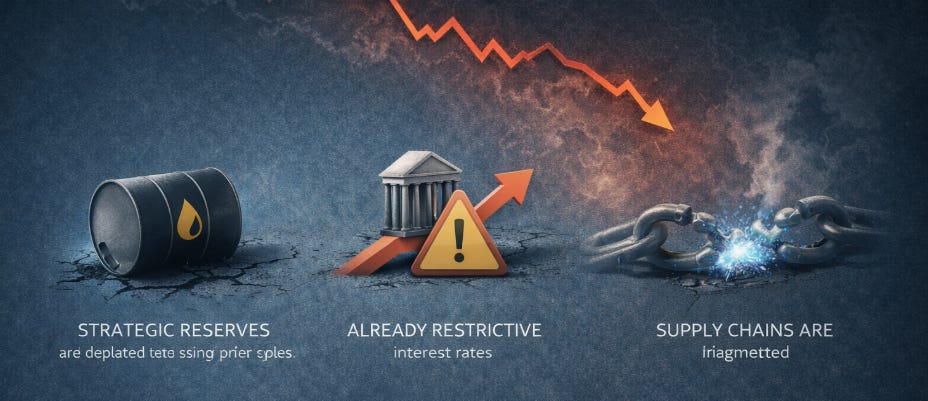
This reduces the system’s ability to absorb shocks.
Resilience is lower. Sensitivity is higher.
The danger is not just the shock itself.
It is the system’s diminished capacity to handle it.
From Disinflation to Reflationary Anxiety
The global narrative had shifted toward disinflation.
That narrative is now encountering resistance.
Energy feeds directly into:
logistics costs
industrial inputs
consumer pricing
The result is not a smooth decline in inflation.
The “Last Mile” has hit a roadblock.
The regime is shifting from Disinflation
to Reflationary Anxiety.
This is not a reversal yet.
But it is a break in trajectory.
The Policy Constraint – Central Banks in a Narrow Corridor
Central banks were preparing to ease.
That path is now constrained.
Cutting rates into supply-driven inflation risks:
reigniting price pressures
unanchoring expectations
Holding rates risks:
further slowing growth
tightening financial conditions
This is not a normal policy trade-off.
It is a constrained corridor where:
flexibility is limited
timing becomes critical
mistakes become costly
Stagflation Drift and Margin Compression
The current environment can be defined as:
Cost-Push Inflation meeting Cooling Demand
This is the core of the emerging risk.
input costs are rising
demand is weakening
pricing power is limited
This leads to a critical transmission mechanism:
Margin Squeeze
Companies face:
higher production costs
limited ability to pass through prices
declining operating leverage
This is where macro turns into micro.
And where markets begin to react:
earnings expectations weaken
valuations compress
volatility increases
This is not full stagflation.
But it is a stagflation drift with earnings pressure.
From Market Variable to Systemic Ceiling
The key shift is conceptual.
The market is no longer asking:
Where will oil prices go?
It is asking:
What does energy constrain?
The focus has moved from price
to system stability.
Energy has evolved from a Market Variable
to a Systemic Ceiling.
It now defines:
how fast economies can grow
how far inflation can fall
how flexible policy can be
The implication is clear:
The market is not just repricing energy.
It is repricing the limits of the system itself.