
The Agent Illusion
The Execution Gap: Closing the Distance Between Capital and Reality
Capital Has Moved Faster Than Reality
The scale of investment in AI has reached unprecedented levels.
hyperscalers committing tens of billions in capex
massive GPU clusters being deployed globally
an escalating race for AI infrastructure dominance
At the same time, AI agents have become the central narrative.
The expectation is clear. AI will move from assistance to execution.

Yet a structural gap is emerging.
Capital has moved ahead.
Infrastructure has scaled.
But real-world impact is still catching up.
This gap defines the current phase of AI.
The Rise of the Agent Narrative
The evolution from copilots to agents represents a logical progression.
Copilots assist.
Agents act.
Autonomous systems operate.
This shift promises:
productivity gains
labor substitution
continuous execution at scale
It is this promise that has justified the current wave of investment.
If AI can execute tasks reliably, it can replace work.
But that “if” remains unresolved.
The Infrastructure – Revenue Mismatch
The most critical issue is not capability.
It is monetization.
The current AI economy can be defined by an:
Infrastructure–Revenue Mismatch
Capital is flowing heavily into infrastructure:
GPUs
data centers
compute capacity
This is reflected in strong performance from hardware players.
But on the application side:
revenue remains limited
pricing power is unclear
sustainable business models are still forming
This creates an emerging concern:
an AI ROI problem
CapEx is being deployed aggressively,
but the corresponding OpEx-driven revenue has yet to materialize at scale.
The system is building capacity faster than it is generating return.
The Execution Gap
The core limitation is not intelligence.
It is execution.
AI has mastered the “Art of Conversation,”
but it is still failing the “Test of Execution.”
AI agents today struggle with:
reliability
long-horizon task consistency
real-world system integration
And more critically:
Hallucination in Action
This is not just about generating incorrect answers.
It is about executing incorrect actions:
calling the wrong APIs
triggering unintended operations
producing outcomes that cannot be trusted
This fundamentally limits deployment in:
enterprise workflows
financial systems
mission-critical environments
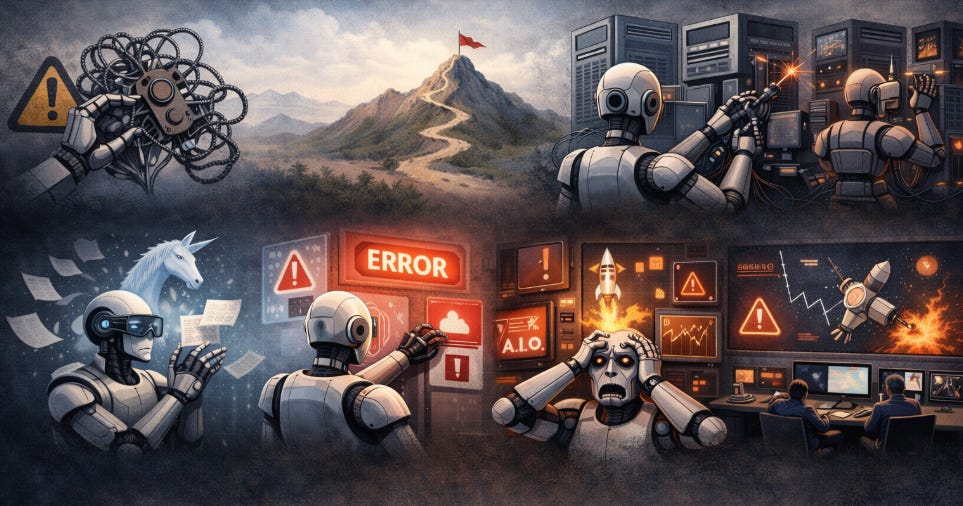
The result is clear:
AI can assist.
But it cannot yet be fully trusted to act.
Why Real-World Impact Remains Limited
The constraint is not just technical.
It is structural.
AI today is still in a transitional phase:
It is not yet deeply integrated into existing industries.
Most industries operate on:
fragmented legacy systems
unstructured data environments
human-driven decision layers
AI requires:
standardized data
system-level integration
operational alignment
This mismatch slows adoption.
The problem is not that AI lacks capability.
It is that the system is not yet ready for it.
The Integration Phase – The Rise of the Last-Mile Integrators
The next phase of AI is not model innovation.
It is integration.
Between 2026 and 2027, the most valuable companies will not be those building models.
They will be:
The Last-Mile Integrators
These are companies that:
connect AI models to real-world workflows
translate abstract intelligence into operational outcomes
integrate AI into fragmented legacy systems
Their advantage lies in solving the hardest problem:
the final step between intelligence and execution.
This includes:
healthcare systems integration
financial workflow automation
industrial process optimization
logistics orchestration
The next wave of value creation will come from
bridging AI with reality—not building AI itself.
Beyond Integration – From Scarcity to Default
However, this opportunity has a finite window.
As AI systems evolve:
AI begins to generate AI
AI begins to optimize its own workflows
integration becomes increasingly standardized
This leads to a structural shift:
Today’s “Strategic Integration”
becomes tomorrow’s “Default Setting.”
When that happens:
barriers to entry collapse
differentiation weakens
new opportunity surfaces narrow
This does not mean growth stops.
It means the nature of advantage changes.
Final Insight
The current AI cycle is not defined by capability.
It is defined by sequencing.
infrastructure precedes application
investment precedes monetization
expectation precedes reality
This is not a failure.
It is a phase transition.
AI is not yet delivering outcomes at scale.
It is still building the conditions required to do so.
The companies that succeed in this cycle
will not be those with the most advanced models.
They will be those who understand the gap—
and close it.