
The One-Person Company
The Shift from Scaling People to Scaling Leverage
The Startup Equation Is Breaking
For decades, startups scaled through a predictable equation. More people, more capital, and more output. Growth required hiring, coordination, and increasing burn.
That equation is now breaking.
AI is not just improving productivity. It is redefining how output is created. The unit of production is no longer the organization. It is the individual.

From Headcount to Marginal Cost Collapse
The most important shift is economic rather than technological.
AI is driving the marginal cost of cognitive labor toward zero. Tasks that once required teams—writing code, designing interfaces, producing content, and supporting decisions—can now be handled by systems.
This breaks the traditional relationship between cost and output. Production no longer scales with headcount. The cost structure becomes flat while output continues to grow.
The implication is clear. The system is moving away from economies of scale and toward economies of speed. The advantage now belongs to whoever can execute faster, not whoever can hire more.
The Emergence of Tiny, High-Leverage Teams
A new organizational structure is emerging across the startup ecosystem.
Small teams, often consisting of one to five people, are building products with meaningful scale. They operate with minimal coordination cost while maintaining high production velocity.
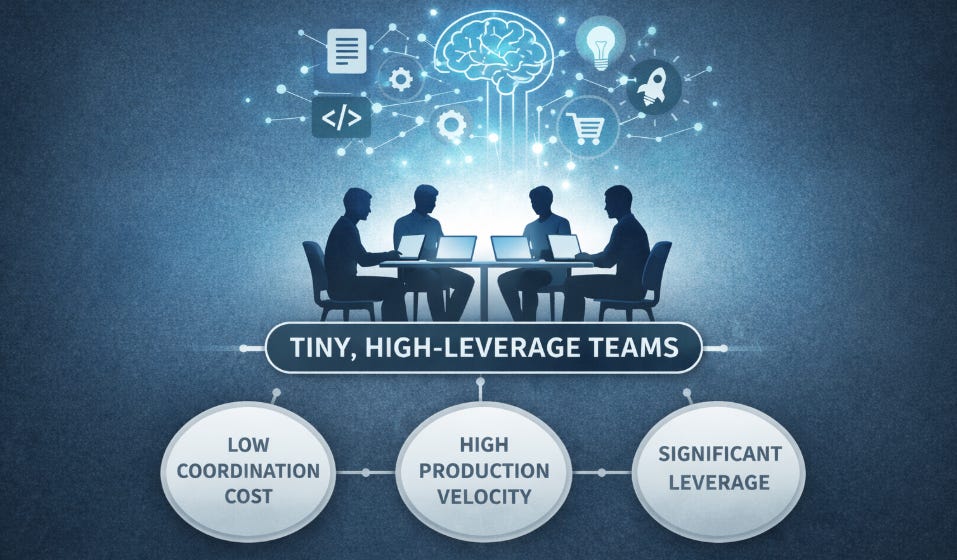
AI tools enable this shift by replacing layers of work that previously required multiple roles. Coding, design, and operational workflows are increasingly automated, allowing individuals to operate with leverage that did not exist before.
This is not simply efficiency. It is a new production model.
From SaaS to SaaL
The nature of software itself is changing.
We are moving from Software as a Service to Software as Labor. Software is no longer just something people use. It is something that performs work on behalf of people.
It can write, generate, respond, and assist in decision-making. As this shift progresses, execution becomes detached from human input. Output can scale without proportional increases in labor.
This accelerates the collapse of marginal cost and reinforces a new model where startups grow by deploying intelligence rather than hiring teams.
The VC Paradox
This transformation introduces a structural tension in venture capital.
The traditional VC model assumes that companies require large teams, significant capital, and extended time to reach scale. AI-native startups challenge each of these assumptions.
Smaller teams can reach meaningful revenue faster and with far less capital. This creates a new category of companies that are both capital-efficient and highly scalable.
For investors, this creates a paradox. Less capital is required per company, yet the potential return per dollar increases. This suggests a shift toward smaller funds and higher multiples.
The era of aggressive capital deployment may gradually give way to a model focused on precision and efficiency.
The New Bottleneck: Distribution and Trust
As production becomes easier, scarcity shifts elsewhere.
The constraint is no longer the ability to build. It is the ability to be seen and trusted.
In a world where supply is effectively infinite, attention becomes the limiting factor. Trust and curation emerge as the true sources of value.
This creates new dynamics. Distribution becomes the primary challenge. Platforms control visibility, and user acquisition remains difficult. At the same time, founders themselves increasingly become part of the product through personal branding and credibility.
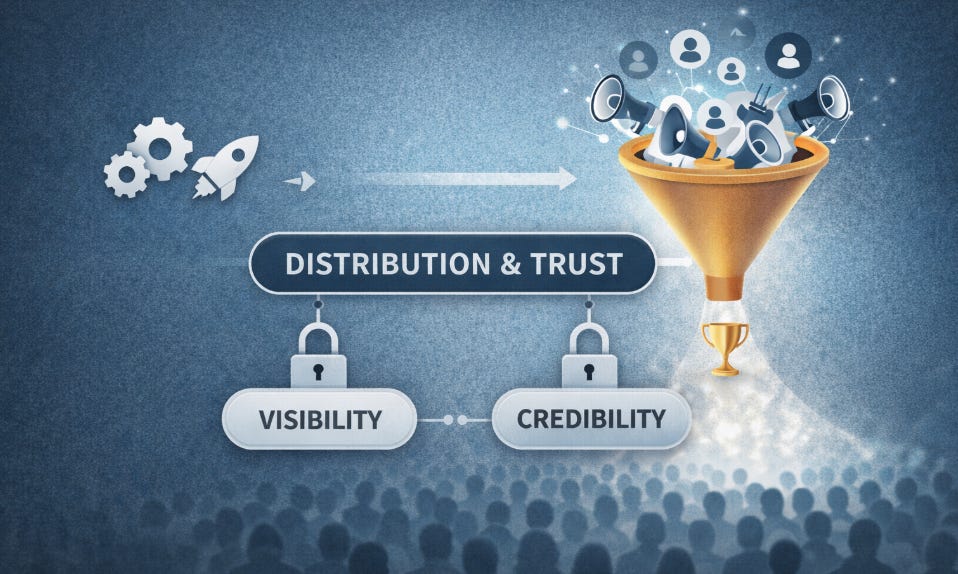
Competition intensifies as barriers to entry fall. Differentiation becomes harder, not easier.
Building is no longer the hard part. Being chosen is.
From Companies to Systems
The startup model is not disappearing. It is evolving.
The shift is moving away from organizations built on headcount and toward systems built on leverage. The defining metric is no longer size, but output per individual.
This has long-term implications for how companies are structured, how capital is allocated, and how value is created.
The most valuable companies of the next decade may not resemble traditional organizations. They will be highly efficient systems designed and operated by a small number of individuals.
The future of startups is not scale.
It is leverage.